Fidget Trading 3D Fidget Toys
- 4.5
- Rating
- 10.00M
- Installs
- Free
- Price
 Analysis by App-foxy
I went into Fidget Trading 3D Fidget Toys expecting a quick, disposable casual game, and that is mostly what I found: a simple trading-and-collecting experience built around the satisfying appeal of fidget toys. Its main idea is easy to understand within moments, which makes it approachable when I want something light rather than a game that demands planning, a long tutorial, or a serious time commitment.
The game comes from MagicLab, is free to play, and is rated for Everyone. It belongs firmly to the casual category, with a 4.5 average from around 143 thousand ratings and more than 10 million installs. Those figures suggest that its immediate, tactile concept has reached a broad audience, but popularity alone does not explain whether it is worth keeping installed. After spending time with it, I think its appeal depends heavily on what you want from a mobile game: it works well as a short distraction, while players looking for deep strategy or a demanding challenge may find it too light.
Why the first few sessions are so easy to understand
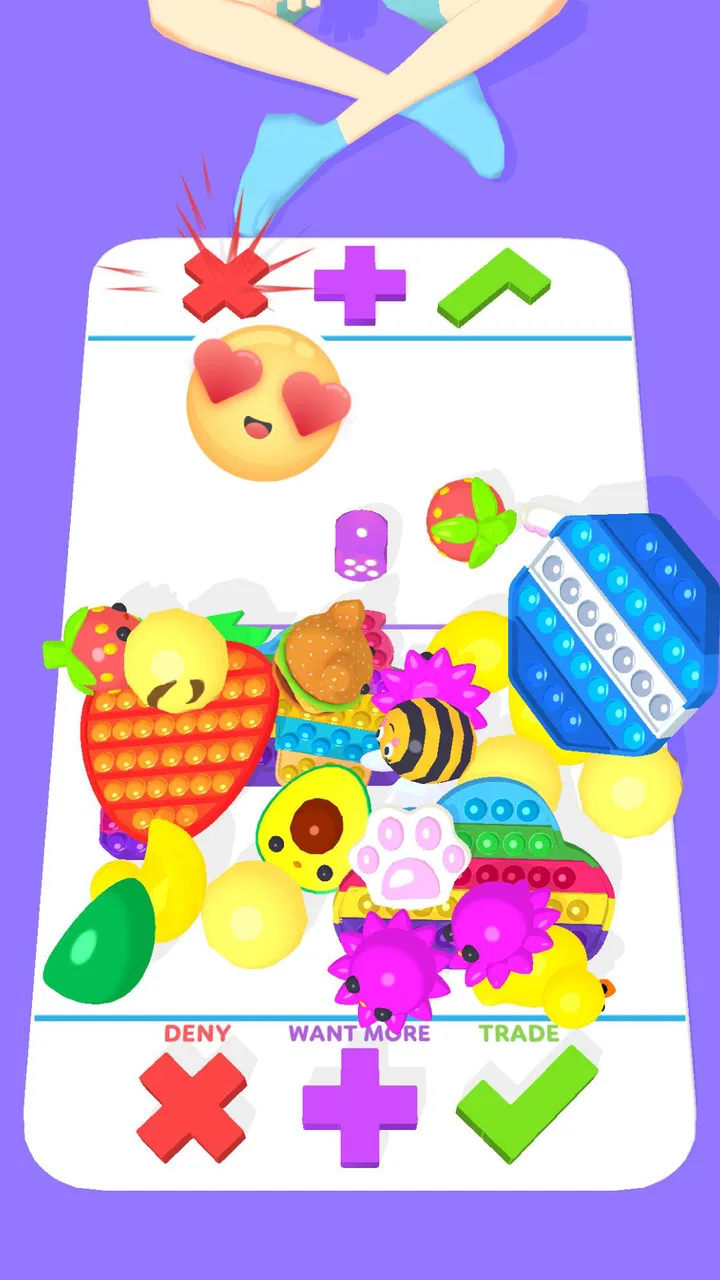
The early goal is straightforward: trade and collect fidget toys while enjoying the visual and tactile presentation. I never felt lost about what the game wanted me to do. That clarity is one of its strongest qualities because the concept does not bury the player under menus, complicated rules, or a large amount of reading. The basic loop can be understood by younger players and by anyone who simply wants to open a game and start interacting with it.
You May Also Like

 Blood Strike: 2.5 Anniversary
Blood Strike’s Loadouts Turn Every Drop Into a Tactical Gamble
A close look at Blood Strike’s custom loadouts: how fast access to signature weapons reshapes its battle royale rhythm, rewards preparation, and narrows the gap between fights.

 Pandora - Music & Podcasts
Pandora’s Music Is Easy to Start, but Harder to Recover
Pandora’s strength is its low-effort path from a seed to a station. Its weak spot is how much confidence it asks you to place in connection, setup, and quiet recovery.

 8 Ball Pool
 Is Built on Rivalries, Rematches, and Routine
A close look at the rivalries, rematches, shared routines, and unanswered safety questions that turn a quick pool match into a persistent mobile community.

 Samsung Music
’s Quiet Strength Is Playing What You Already Own
Its reach comes less from spectacle than from dependable access to a personal library. That simplicity is both the app’s strongest retention engine and its ceiling.

 AccuWeather: Weather Radar
AccuWeather Review: A Quick, Clear Forecast for Everyday Decisions
For everyday plans, the best forecast is the one you can understand quickly. AccuWeather makes rain timing, radar, and local conditions easy to act on, with a few trade-offs.

 Hill Climb Racing
Why Hill Climb Racing Still Turns Crashes Into One More Run
A tiny car, a bumpy hill and one more upgrade: Hill Climb Racing keeps resurfacing because its simple chaos makes every near-miss feel personal.
More From Our News Desk



That simplicity also gives the opening sessions a pleasant rhythm. Each interaction feels like a small step toward building a collection, and the collecting element gives the actions a little more meaning than tapping through a completely aimless toy simulator. I found myself paying attention to what I had already gathered and what might come next, even though the game remains intentionally relaxed.
For an everyday example, I can see this fitting neatly into a short break between tasks. If I have a few minutes while waiting for an appointment or taking a pause from work, I can play without needing to remember a complicated storyline or reconstruct a strategy from the previous session. It is also suitable for sharing with a child who enjoys colorful objects and collecting, although an adult should still use normal judgment about screen time and in-app purchasing habits in any free game.
The important point is that the early objective is not really about mastering a complex system. It is about the satisfaction of completing small exchanges and seeing the collection develop. Players who enjoy organizing, gathering, and repeating a clear action will understand the attraction quickly. Players who need a strong narrative reason to continue may feel that the premise is too thin.
What makes the collecting loop feel rewarding
The collection provides the clearest progress signal. Rather than relying on a dramatic story, the game gives the player a sense of movement through the things being obtained and the visible changes that come from continuing to trade. I prefer this kind of progress when I am playing casually because it does not ask me to memorize a large set of rules. The reward is immediate and easy to read.
A useful way to approach it is to treat each session as a small collecting task instead of expecting a complete gaming experience every time. I found that the game feels better when I stop after a natural sense of completion rather than forcing a long session. That keeps the fidget-to-fidget interaction pleasant and prevents the repetition from becoming too obvious too quickly.
One non-obvious strength is how accessible the progress language is. A player does not need to understand genre conventions such as character builds, equipment statistics, or complicated resource economies to recognize improvement. That makes the game a reasonable introduction for someone who is not normally interested in mobile games. It also makes it easy to hand the device to another person without spending several minutes explaining the controls.
At the same time, this accessible progress has a limit. Because the collection itself is the main reason to continue, the sense of achievement can weaken if the player does not care about completing or expanding it. There is no guarantee that every new item will feel meaningfully different to every player. The game’s satisfaction comes more from the act of obtaining and interacting than from a deep strategic consequence attached to each object.
How the difficulty develops without becoming a serious test
The difficulty curve is gentle compared with action games, puzzle games, or competitive titles. I would not describe this as a game that constantly tests reflexes or demands careful optimization. Its challenge is closer to maintaining interest through repeated interactions and continuing to pursue the next collecting goal.
That pacing is a good match for the game’s audience. A harsh difficulty spike would work against the relaxed fidget-toy concept, especially for players who want something calming. I appreciated that the game does not immediately turn its simple premise into a stressful contest. It remains approachable, and the low barrier to entry is part of its identity rather than a missing feature.
However, a gentle curve also means that experienced players may reach their personal limit quickly. If you usually play games for difficult decisions, precise timing, or a demanding mastery path, this may feel more like a digital pastime than a full challenge. The game is not at its best when judged by the standards of a competitive or strategy-focused title.
My practical advice is to decide what kind of challenge you want before downloading it. If your ideal session involves a few satisfying actions and a visible collecting objective, the pacing is comfortable. If you want every session to demand more skill than the last, you may prefer a puzzle game, an arcade game, or another casual title with stronger escalation.
Where the pacing works and where repetition shows
The pacing works best in short bursts. The central activity is immediately available, and the game does not need a long setup before it becomes enjoyable. I could pick it up, make progress, and put it down without feeling that I had abandoned an important mission. That makes it more flexible than many games that depend on long rounds or uninterrupted attention.
The trade-off is repetition. A simple loop can be satisfying precisely because it is predictable, but predictability can also expose the limited depth. After the novelty of the fidget toys and trading interactions settles, the player’s motivation depends on whether collecting alone is enough. I noticed that the game is more enjoyable when I approach it as a relaxing activity rather than expecting a constantly changing experience.
This is also where the free model affects my expectations. Since the game costs nothing to download, it is easy to try without much commitment. Still, free casual games often encourage players to keep chasing the next reward, and I think it is wise to set a personal stopping point. I would not let the collection loop decide how long I play. A short session feels intentional; an extended session can start to feel like repetition for its own sake.
Another useful tip is to avoid comparing every new interaction with the excitement of the first few minutes. The opening has the advantage of novelty, while later play is about routine collection. If you enjoy routines, that is a strength. If you need frequent surprises, the game may lose its pull sooner than you expect.
Does it create healthy motivation to return?
The retention pressure is relatively soft from the perspective of the core idea. The game encourages returning through the desire to trade more and expand the collection, rather than through a story that leaves a dramatic cliffhanger. That makes it easy to play on your own terms, but it also means the long-term reason to return is personal. Some players will enjoy gradually gathering more fidget toys; others will feel they have seen enough after a handful of sessions.
I think this is an important distinction for parents and for anyone trying to keep their phone use under control. The game’s accessible loop can make it tempting to continue because the next small reward is always more appealing than stopping immediately. My preferred approach is to decide in advance whether I am playing for a short break or for a particular collecting target. That small boundary keeps the experience from turning into automatic scrolling with extra steps.
The game is also less suitable for someone who wants a strong sense of permanent achievement. Collecting can feel rewarding, but it does not necessarily change how you think about later actions. If your ideal progression involves unlocking new abilities that alter the way you play, a deeper game will probably serve you better. Here, the motivation is mainly visual, tactile, and completion-oriented.
Still, the softer retention design is part of its charm. I do not need to remember a complicated schedule or maintain a competitive rank to enjoy it. I can return after a break and immediately understand the activity again. That makes it more forgiving than games that punish missed sessions or require constant attention, at least from the straightforward perspective of its casual play loop.
Who will enjoy it most
I would recommend this game to players who like collecting, simple interactions, and fidget-themed presentation. It is especially suitable for short sessions, relaxed play, and people who do not want to learn a complicated system. The Everyone rating reflects how broadly approachable the concept is, and the basic objective is clear enough for a wide range of players.
It can also work as a low-pressure introduction to mobile gaming. Someone who finds role-playing games overwhelming or competitive games stressful may appreciate the directness here. There is no need to understand a large fictional world before enjoying the first session. The game communicates its purpose through interaction, which is more welcoming than a text-heavy opening.
I would skip it if I were searching for a substantial campaign, deep tactics, or a difficult skill challenge. I would also be cautious if collecting mechanics tend to make me play longer than intended. The game’s simplicity is a benefit only when simplicity is what I want. If I am already tired of repetitive reward loops, this particular concept is unlikely to change my mind.
How it compares with other casual choices
Compared with a traditional puzzle game, this experience asks less of my problem-solving ability. A puzzle title usually gives me a clear obstacle to analyze and overcome, while this game focuses more on the satisfaction of trading and collecting. Compared with an arcade game, it is less about precision and speed. Compared with a virtual pet or toy app, it adds a more defined collecting purpose rather than offering only open-ended interaction.
That position is useful because it explains both its appeal and its limits. It is more structured than a simple digital toy, but less demanding than a strategy or puzzle game. I would choose it when I want a guided, fidget-centered activity. I would choose an alternative when I want a stronger sense of mastery, a story, or a challenge that keeps evolving.
The game’s scale also matters. MagicLab has kept the premise focused rather than turning it into a broad genre hybrid. I like that focus during short sessions because the game gets to its point quickly. On the other hand, players hoping for a large number of interconnected systems may see the narrow design as a reason to move on.
Device requirements and practical expectations
The current version is 2.0.6, and it requires Android 8.0 or later. That makes the compatibility question fairly simple for Android users: check the device’s operating system before installing, especially if the phone or tablet is older. The game is free, so trying it does not require an upfront purchase, but I still recommend treating any optional spending in a free game carefully and involving a parent or account holder when appropriate.
I would also approach the install with realistic expectations about what it is. The game’s large audience, including more than 10 million installs, tells me that the concept is easy for many people to pick up, not that it offers the depth of a premium release. Its value is in quick access, clear collecting goals, and fidget-focused entertainment.
Before giving it to a child, I would set the same boundaries I use with any free mobile game: decide how long the session should last, check the device’s purchase protections, and make sure the player understands that continuing to collect is optional. Those habits matter more than the game’s simple presentation because repetition can make a short activity stretch into a much longer one.
My progression verdict
After playing it, I see Fidget Trading 3D Fidget Toys as a focused casual game whose progression succeeds through clarity rather than complexity. The early goals are understandable, the collection gives visible direction, and the difficulty stays gentle enough for relaxed play. I especially like that I can return after time away without relearning a system.
The main weakness is equally clear: the same narrow loop that makes it accessible can make it repetitive. The game does not offer the kind of escalating mastery that would keep every serious player engaged. Its long-term appeal depends on whether the act of trading and collecting remains satisfying for you, not on a deep challenge or a powerful narrative.
My final recommendation is simple. Try it if you want a free, Everyone-rated casual game for short breaks and enjoy fidget toys or collection-based progress. Keep your sessions purposeful, because the most satisfying way to play is in small doses. Skip it if you are looking for strategy, demanding difficulty, or a progression system that substantially changes the way you play. For the right player, MagicLab’s game is a pleasant little collecting distraction; for everyone else, its limited depth will become apparent fairly quickly.
FAQs for Fidget Trading 3D Fidget Toys
01What is Fidget Trading 3D Fidget Toys?
Fidget Trading 3D Fidget Toys is an interactive mobile game where players can engage in virtual trading of various fidget toys. The game involves negotiating trades with in-game characters, aiming to collect a wide array of toys. It combines elements of strategy and collection, making it appealing for both casual and dedicated gamers.
02How do I play Fidget Trading 3D Fidget Toys?
Playing Fidget Trading 3D involves selecting toys from your collection to offer in trades with virtual opponents. You’ll need to assess the value of the toys, make strategic offers, and decide when to accept or reject deals. The goal is to expand your collection with rare and unique fidget toys.
03Is Fidget Trading 3D suitable for children?
Yes, Fidget Trading 3D is designed to be child-friendly. It features simple controls, colorful graphics, and a non-violent trading system that encourages strategic thinking. Parents should review the game’s content and in-app purchase options to ensure it aligns with their preferences for their children.
04Does Fidget Trading 3D require an internet connection?
Fidget Trading 3D can be played both online and offline. While an internet connection is not required for basic gameplay, certain features, such as accessing leaderboards or new toy packs, may require online connectivity. Offline mode allows you to enjoy the core trading experience without interruptions.
05Are there in-app purchases in Fidget Trading 3D?
Yes, Fidget Trading 3D includes in-app purchases. Players can buy additional toy packs, remove ads, or acquire premium features that enhance the gameplay experience. While these purchases can enhance the game, they are entirely optional, allowing players to enjoy the game without spending money.
Pros
- Engaging and addictive gameplay.
- Wide variety of fidget toys available.
- Simple and intuitive controls.
- Colorful and appealing graphics.
- Regular updates with new features.
Cons
- Contains frequent ads.
- In-app purchases can be expensive.
- Limited offline functionality.
- May drain battery quickly.
- Lacks multiplayer mode.

Fidget Trading 3D Fidget Toys
Gallery